Monday, July 27, 2020

Alpha - Omega

A question I received:
"Is the God of the Hebrew scriptures, the same as Jesus Christ? The reason I ask, is because they both refer to themselves as "the Alpha and the Omega". Does this mean that their nature is the same?
My reply:
I will put the definitions of the words in each referenced verse, in parenthesis. The scriptures you refer to, are Rev.1:11 KJV ("Alpha&Omega", "most before and last"), 
Rev.1:17-18 ("most before and last")-(Jesus died- Heb.2:14) (God never dies- Hab.1:12) 
Rev.1:8 ("Alpha&Omega", "original and finish/consummation"); 
-------("Lord God: Greek: "Master" -John13:13 KJV) ("Almighty": Greek: "all-holding" -John3:35; Matt.11:27)
Rev.21:6; ("Alpha&Omega", "original and finish/consummation")(John4:10; Rev.22:1; Ps.36:9; John12:49-50) 
Rev.22:13 ("Alpha&Omega", "original and finish/consummation", and, "most before and last")... (all references of which, could be Jesus). Both Alpha and Omega, are Greek letters. They are not found in the Hebrew scriptures. 

Jesus Leaving the Tomb Cross stitch Pattern Chart needlework | Etsy  Rev.1:17-18

When it comes to God having the traits of being First and Last; we can however, consider Isa.41:1-2,3-4; 44:6; 48:3-5,6-8,9-11,12-13; Rev.4:8,11; 11:15-17
Nothing about Alpha or Omega, means 'the same nature'. That is not to say that God and Christ are not the same nature [they are both divine spirit, just as all sons of God become (2Pet.1:4; John10:34-35; Ps.82:6)], but that similarity of nature, is not expressed in either "Alpha' or 'Omega'. (https://4womaninthewilderness.blogspot.com/2015/01/who-are-gods.html)
Neither do each of those words mean "uncreated, eternal, atemporal, or timeless".
At John 1:1, it reads; "In the beginning".
That of itself is speaking of a moment in time, a start... not eternity. That verse continues... "In the beginning, the Word/Logos, was."
We are told that the Word exists, "In the beginning" of God's creation
(John1:1; 8:58; 1John1:1; Prov.8:22-24,25-27,28-31; Micah 5:2; Col.1:15-17; Heb.1:2; Rev.3:14; John17:5).
Alpha and Omega simply mean, First and Last.

Can two different identities be first and last, and remain two different identities?
Of course. As a simple example, an only son is the first and last son. If he marries and has an only son, that son is also, first and last. Yet they remain, two different people.
But how does this compare to the identity difference between God and Christ, while both of them are Alpha and Omega... First and Last?
The Bible tells us.
The Logos, was the first of all creation. Jesus Christ is the FIRSTborn of the New Creation (Rom.8:29; 2Cor.5:17; Rev.1:5).
But that NEW creation, finally allows God to enter His Sabbath Rest permanently, and able to declare with finality, all things Good. He made that declaration at the end of the physical creation (Gen.1:31; 2:2), but it did not last (Gen.6:5-6; Rom.8:20-22; John5:17; Heb.4:9-11).
The start/FIRSTborn of that NEW, incorruptible creation, is the resurrection of Christ... the LAST Adam (1Cor.15:45) because from him (the "eternal father" -Isa.9:6) all others receive life. He is the Alpha (FIRSTborn born of the New Creation) and Omega (LAST Adam/man, needing to be created) of the New Creation, because all those after him, come from him.
"So it is written: "The first man Adam became a living being"; the *last Adam, a life-giving spirit."* Does this mean that when God declares Himself Alpha and Omega, that he is saying that He is Jesus Christ? No, because God tells us what He means, by being the first and the last...
Isa.43: "10 “You are My witnesses,” says the Lord,
“And My servant whom I have chosen,
That you may know and believe Me,
And understand that I am He.
Before Me there was no God formed,
Nor shall there be after Me."
So, Is God the *first Almighty God? Is He the *last Almighty God to ever be?

Can any other god be compared to him, or be equal to him ", including His eternal sovereignty?
How then, would He come to be "in the likeness of men"? 
He did not. The Logos/Jesus, did. No creation, compares to the eternally unchanging Father of Jesus Christ. (Phil.2:7; Isa.40:18,25,28; 43:13; Ps.93:2).

So, two different persons can share being first and last, but that does not mean that they are first and last in the same regard, or to the same degree, or must be the same person.
Both Jesus and God can be described as an Alpha and Omega; but that does not mean that they are the same person, or first and last in the same way.
Yes, the Logos emptied himself, became a human, and even died.
Major changes.
Yet God never changes...
(Ps.90:2; 102:24,27; Mal.3:6; James1:17; Gen.21:33; Job.36:26; Jer.10:10; Hab.1:12) 
If He is indeed the peerless God, from everlasting, to everlasting (Ps.90:2)... then He has never died (Hab.1:12).

Wednesday, July 1, 2020

Don't Look Back

Don't look back, was the theme of many cautionary warnings that Jesus gave us. It is therefore crucial that we gain insight into the significance of what he meant. As we will see, it is especially suited for the time of the End, in which we live.

Luke chapter 17 reads; "28 ‘It was the same in the days of Lot. People were eating and drinking, buying and selling, planting and building. 29 But the day Lot left Sodom, fire and sulphur rained down from heaven and destroyed them all.
30 ‘It will be just like this on the day the Son of Man is revealed. 31 On that day no one who is on the housetop, with possessions inside, should go down to get them. Likewise, no one in the field should go back for anything. 32 Remember Lot’s wife! 33 Whoever tries to keep their life will lose it, and whoever loses their life will preserve it."
In verse 32, Jesus tells us to remember Lot's wife. So let's go look and see how the account of Lot's wife can aid us in understanding the meaning, of not looking back.
Genesis chapter19 reads; "15 With the coming of dawn, the angels urged Lot, saying, “Hurry! Take your wife and your two daughters who are here, or you will be swept away when the city is punished.” 16 When he hesitated, the men grasped his hand and the hands of his wife and of his two daughters and led them safely out of the city, for the Lord was merciful to them. 17 As soon as they had brought them out, one of them said, 'Flee for your lives! (Jer.51:6) Don’t look back, and don’t stop anywhere in the plain! Flee to the mountains or you will be swept away!' (Matt.24:15-16) 24 Then the Lord rained down burning sulfur on Sodom and Gomorrah—from the Lord out of the heavens. 25 Thus he overthrew those cities and the entire plain, destroying all those living in the cities—and also the vegetation in the land. 
26 But Lot’s wife looked back, and she became a pillar of salt."

Sex in Genesis: Is the Sodom Story Literal?
Clearly, the warning we take away from Jesus' words at Luke 17:32-33,31 is a warning against looking back. It entails leaving the life we had known, behind, for the sake of the truths of Christ (Luke 17:32-33; Mark 8:35).

What does it mean to not look back?
What is the tugging temptation that is drawing upon us, making it a challenge to not look back?
What effect does looking back have on us?
What is so dangerous about looking back?
What are the challenging consequences that result, from our not looking back?
What fine consequences result from our not looking back?
How can I apply this warning in my personal life?

1. What does it mean, to not look back?

Paul teaches us, that there are really only two choices... our own life, or a life lived for the sake of the truths of Christ (Mark 8:35 KJV).
Philippians chapter 3;
"What is more, I consider everything a loss because of the surpassing worth of knowing Christ Jesus my Lord, for whose sake I have lost all things. I consider them garbage, that I may gain Christ and be found in him, not having a righteousness of my own that comes from the law, but that which is through faith in Christ – the righteousness that comes from God on the basis of faith. 10 I want to know Christ – yes, to know the power of his resurrection and participation in his sufferings, becoming like him in his death, 11 and so, somehow, attaining to the resurrection from the dead.
12 Not that I have already obtained all this, or have already arrived at my goal, but I press on to take hold of that for which Christ Jesus took hold of me13 Brothers and sisters, I do not consider myself yet to have taken hold of it. But one thing I do: forgetting what is behind and straining towards what is ahead14 I press on towards the goal to win the prize for which God has called me heavenwards in Christ Jesus."
There we learn that not looking back, means to minimize the importance of our own life (Acts 20:24), so that our total focus is on the will of God for us. It means letting go of what may have held great value to our heart, in favor of using our whole mind, heart, soul, and strength, in the service of God, Christ, and others (Matt.22:36-37,38-40).
When we strive with our whole soul toward a goal, our heart is not divided by our futile desires
(Matt.6:19-21,24;  1Tim.6:6-8,9-11,12-14,15-17,18-19; Matt.6:20; Mark 10:24-25; Job 1:21; Luke 12:20-21; Ps.49:17; Ecc.5:15; 1:14).

2. What is the tugging temptation that is drawing upon us, making it a challenge to not look back?

We all have personal things we each treasure, aspire to, enjoy doing, and hope for.
Looking back need not be only our past. It can also be all the things we value, desire, and meditate on... previous to our dedication to the will of God.
Learning to treasure the will of God for our life, above and beyond our own desires, is a progressive maturation (Matt.6:31-32,33; Rom.12:1-2; James 1:4). No one naturally wants to disown themselves in favor of slaving for someone else's will (2Cor.5:15; Rom.6:6,13). Jesus gave us his example, as a perfect lesson of what it means to live for God. We learn to leave our self-centered life behind, and we don't look back.
(Heb.12:2-3; John 4:34; Luke 22:42; Matt.16:21-23,24-25; Mark 9:47;  1Cor.9:24-25,26-27; Job 17:9)

3. What effect does looking back have on us?

Luke chapter 9 reads;
"62 Jesus replied, ‘No one who puts a hand to the plow and looks back, is fit for service in the kingdom of God.’"

Why did Jesus compare our being a useful servant of God's sovereignty, to a farmer ...plowing the ground for the planting of seed?
This comparison within the Bible, is not new. The Bible compares the Word of God, to seed (Luke 8:11). It compares the spiritual fertility of our heart, to soil 
(Luke 8:15; Hosea 10:12; 6:3; Isa.44:3; 45:8;  2Cor.9:10; Jer.4:3; Luke 8:14;  1Cor.3:6; Eph.3:16-17).
From those verses we see, that the purpose of symbolic rain from heaven [living waters (Rev.22:1; John 4:10,14), is to nurture our growth in righteousness, sanctification, and holiness, by the blessing of God's spirit. We too must supplement God's blessing, by contributing a plowed heart... soil that is softened to accept God's Laws (Heb.10:16) and the life they impart (Rom.8:11,2; Gal.6:8; Prov.6:20-21,22-23).
We must strive for progressive understanding... nurturing our growth in the knowledge of God within us (John 6:27; Phil.1:9). Such work takes focus, effort (Gal.6:9;  2Cor.7:1; Matt.5:48;  1Thess.4:2-3,4; 5:23; Prov.11:18) and sacrifice (Matt.13:44; Rev.3:18; Ps.90:12; Prov.23:23), ...but is rewarded and blessed by God (Heb.6:7; John 4:36; Acts 14:17; James 5:7,18; Rev.22:2; Luke 6:43,45; John 15:16) (Matt.16:17; 13:11,16).
Such is the result for those who plow their heart with their focus on the goal ahead. That goal is the harvest and blessing from God, of righteousness (2Cor.9:10; Isa.45:8; Rom.4:3-4).

At Luke 9:62, Jesus states that those who look back, are not fit for service.

Following Jesus Down Rejection Road | Block Island Times

Farmers who plow for optimal result, make optimal use of their field (Eph.5:15-16,17). They choose a landmark in the distance (Heb.12:2), assuring that their plow-line will be straight. On their return run, they do the same, making certain that the whole field will be overturned and prepared.
We cannot bring "perfect holiness" to completion (2Cor.7:1), if our spiritual goals are haphazard,
and our effort is ambivalent, inconsistent, cursory, superficial, or partial
(Hosea 8:7; James 1:4-5,6-7,8; Luke 8:18).

4. What is so dangerous about looking back?

Preparing our heart to fully accept the wisdom of God, and be undivided for the service of God's kingdom, is a protection (Ecc.7:12).
God's wisdom illuminates our heart, so that we can perceive the way of life (Prov.18:15; 23:23)
(John 8:12; 12:49,36; 6:63; 1:4;  2Cor.4:6; Ps.119:105;  1John 1:5;  1Pet.2:9; Col.1:13).
If we remain in darkness, we are an easy target for our adversary 
(1Pet.5:8-9; Eph.6:10-12,13-15,16-17;  1Thess.5:4-6,7-9; John 12:35).
A weak and disoriented target, is much easier to overcome than a strong and wise one.
If we have not built our faith, solidly upon the teaching and example of Jesus; we will not be able to continue standing through persecution (Luke 22:31-32; Matt.7:24-25,26-27; Luke 21:36). We may give in to our personal desire to hold on to the approval of people, retain a position, or prevent other losses that are common occurrences among Satan's targeted enemies (Mark 8:35).

5. What are the challenging consequences that result, from our not looking back?

Even those who are striving to serve and please God, are destined to have an intense struggle.
(1Pet.5:8-9; 4:13; John 15:18-19,20; 16:20-22;  1Thess.3:3; Acts 14:22; 20:24; Rev.1:9; Rom.8:17;  2Tim.2:3; Phil.3:10; Heb.12:2-3).
Jesus likened our enduring persecution, to a woman in childbirth (John 16:21-22).
Additional scriptures provide more insight into such suffering, panting, and need for endurance
[Jer.4:31; Isa.26:17; 42:14; Ps.63:1-3,4-6,7-8; 119:131; 42:1 <(lit.panting for water); Hab.2:3 <(lit."panting to the end");
Rev.12:2; Dan.9:26; Rev.14:12; 13:10).
We may only endure to the end (Matt.24:13;  2Tim.4:5-6,7-8; Rom.2:6-8), by determination and single-minded devotion.
We cannot afford, to look back.

What do contractions feels like? | ABC

If we do, we are in danger of becoming overwhelmed, distracted, and violating the vital warning of Jesus that we should not to return to the things we left behind (Luke 21:21-22; 17:30-31,32-33).
If we do, we will succumb to the temptation that ensnared Lot's wife.

6. What fine consequences result from our not looking back?

Those who become conquering victors, are to be rewarded
(2Tim.4:7-8; James 1:12; Rev.2:10,7,11,17,26-27; 3:5,12,21; 12:11; 17:14; 21:7)
(John 14:21; Rom.8:28,31,35-37,38-39; John 16:33; Luke 22:28-29; Mark 10:29-30).

7. How can I apply this warning in my personal life?

Those who are called, chosen, and anointed by God's spirit to be a priest of his spiritual Temple...
 (1Pet.2:5,9; 1:5-6; 5:10;  1Cor.3:16)
(Acts 7:49-50; Zech.8:8; Eze.37:27;  2Cor.6:16; John 14:23),
...must prove faithful to that calling
(Rom.11:29; 8:28-30; Eph.4:1,4; Phil.3:14;  2Thess.1:11;  2Tim.1:9; Heb.3:1;  2Pet.1:10).
Once we are sealed as a faithful part of that Temple, we do not leave that station
(Rev.3:12 -A ; Heb.8:4-6,1-2; 9:23; Col.2:17).
Our life is not our own, and our Temple service, is forever.
(1Cor.6:19-20; John 1:51; Rev.22:3-5; 7:15; John 1:51; Gen.28:12-14; Gal.3:29; Col.3:24)
(Heb.7:15-17; Rev.5:9-10; Dan.7:14,21-22,26-27).
Such priests must learn, to not look back at the life and losses they leave behind
(Rom.8:17-19,24-25). Under the sifting persecution of Satan, the losses endured by the faithful continue to mount up, as they progress on the path of Christ. If they look back with undue sentimentality, sorrow, or regret; it is unlikely that they will have the fortitude to finish their course (Prov.24:10 KJV ; Isa.40:31; Acts 1:8; Luke 22:31-32; Neh.8:10).

What if we have not been anointed as a priest of God's heavenly Temple?
Jesus said that such priests, must teach others to obey the same commands which they themselves must observe (Mal.2:7; Matt.28:19-20).
Whatever our place in God's purpose; each of us must learn to love and serve God and others, with all that we are (Matt.22:36-37,38-39,40).
But how we serve, and what is expected, varies.
If we are not a priest or member of the Body and Bride of Christ, we can offer support to those who are. Then we can be rewarded, along with all those who serve the Purpose of God.
(Luke 12:48; Matt.25:15; Eph.4:11; Heb.6:10-12; Matt.10:41-42; 25:35-36,37-38,39-40; 22:8-10; Rev.22:17).
We can examine ourselves and know what God's will is for us personally, according to our own capacity, ability, divine position, and relationship with God.
The yoke of Jesus is kindly and light (Matt.11:28-30; 12:20).
Based upon our own relationship with God, we can discern what his purpose is for us, and what he expects of us personally, in this time of the End.
When we have discerned God's purpose for us; let us make the attainment of that purpose, our wholehearted objective.
When that purpose clarifies to us, we know our own path of life and how to live in harmony with the will of God for us. As we progress upon that path, we are cared for by our loving shepherd. We may secure our own prospect of great and eternal joy. as we serve our Father and His son in heaven.
All of us have no reason, to look back.

(https://4womaninthewilderness.blogspot.com/2016/01/is-leaving-city-enough.html)

(https://4womaninthewilderness.blogspot.com/2017/01/what-must-we-do.html)

Wednesday, June 3, 2020

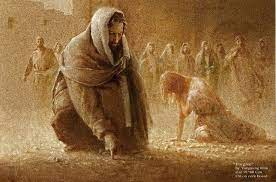
What was Jesus Writing in the Dust?

A question I received:

Pearl, 
Can you please tell me what Jesus was writing, when he bent down to the ground at John 8:3-9?
-  -  -  -  -  -  -

My Reply:

The first thing that the context reveals to us, is that this situation arose because the religious leaders wanted to entrap Jesus, by putting his teaching to the test (John 8:3,6). Take note that the first thing he did in response to that challenge, was to start writing on the ground (John 8:6).

Regarding such challenges to entrap him; Matt.22:18 reveals that those who do this, are hypocrites with evil intent.
Mark 7:6 shows us more about the nature of such hypocrites. Though they teach some Bible truths, they do not live them (Matt.23:3).

Having hearts "far removed from" God; we see from this situation with the adulteress, that their inclination is to condemn, and not to forgive. What is God's judgment for such hypocrites? (John 8:7)
Matt.6:15 explains.
What is the destiny of those whose sins are not forgiven by God? 
Job 7:21 NLT tells us that they descend into the dust, and cease to exist.

Next comes a very helpful scripture, for our answer to your question.
Jer.17:13 
Lord, you are the hope of Israel;
    all who forsake you will be put to shame.
Those who turn away from you will be written in the dust
    because they have forsaken the Lord,
    the spring of living water."


These leaders who sought to entrap the Son of God, were forsaking the Lord. He sent them His only son... the source of living water (John 4:10,13-14; 1:9-12,14,29,31,34; Matt.15:24). 
The result to those who reject and murder the chief agent of life? 
(See Acts 3:13-15; John 3:18)
Ec.9:5 reads;
"For the living know that they will die,
    but the dead know nothing;
they have no further reward,
    and even their name is forgotten."

As Job 7:21 NLT had stated, "For I shall soon lie down in the dust;
    you will search for me, but I shall be no more."

As those who are not forgiven; Ps.109:15 applies...
"May their sins always remain before the Lord,
    that he may blot out their name from the earth."

What was Jesus writing in the dust?

Writing a name down, establishes God's judgment of condemnation or favor 
(Deut.29:20; Mal.3:16; Dan.12:1; Luke 10:20; Heb.12:23; Rev.2:17; 13:8; 17:8; 20:15; 21:27).
Jesus was testifying to those who sought to condemn and murder the adulteress (Matt.9:13; 6:15), 
that their wicked and hypocritical scheme, brought condemnation upon they themselves (Matt.7:2).
Indeed, they were hypocrites (John 8:7).
For they themselves were guilty of being spiritual adulteresses...
(Isa.1:1,21; Jer.23:10-12; Matt.23:33-34,35-36,37-38)
...while condemning others to death.

"Those who turn away from you will be written in the dust because they have forsaken the Lordthe spring of living water." (Jer.17:13NIV)


Tuesday, June 2, 2020

Who are the Good and Bad, invited to the Wedding Feast?

A comment/question, left at the end of the post, "Who is Worthy".
as follows;
"The Feast is bounteous, indeed!! Please, what does it mean that the invitees to this Feast being "both good and bad" (Matt.22:8,9,10)?"
-  -  -  -  -  -  -

My Reply:

As you may know, I seek to derive anything I teach, from scripture. 
Please consider the scriptures to follow, as regards my reply to your question. After reading them, I will cluster them according to the point we can glean, and add my own comment to those clusters, for your further consideration. I will summarize each scripture cluster with how I see their application, to your question about Matt.22:10.

Gen.3:13,22; 1Tim.6:20; Lev.27:12 ESV; 1Cor.6:2-3; John20:22-23; Matt.18:18; Ec.9:2; 1Pet.3:14-15,16-17; Zech.13:9; Mark 8:35; Rev.9:15,20-21; Matt.12:33; Luke 6:43-45; 2Cor.5:10; Matt.13:48 ESV; Matt.13:41 ESV; Matt.24:31; Rev.14:14-19

Gen3:13,22; 1Tim.6:20

"‘The snake deceived me, and I ate.’
"opposing ideas of what is falsely called knowledge"
"The man has now become like one of us, knowing good and evil."
My first learned point, is that the nature of good and bad/evil,
and the difference between them, is...
Good: not mislead, knowing truth
Bad/Evil: mislead, believing falsehood

Application to Matt.22:10: 
Both those who perceive, value, and pursue truth and light, 
and those who do not, will be offered (invited to) the marriage feast.

Lev.27:12 ESV; 1Cor.6:2-3; John20:22-23; Matt.18:18

The priest will evaluate and set/judge, the estimation of what is good and bad.
The saints (as God's priests) are authorized to pass judgment.
Jesus empowers them with holy spirit, so that they can judge sinners.
That judgment leads to either being set free by truth, or bound in Hades.

Application to Matt.22:10:
Since the priests are the ones through whom the marriage feast is provided, it is their preaching and testimony that can set a person free from deception (Mal.2:7; Rom.1:16; Matt.10:12-13,14-15), thereby offering the light of life (Matt.5:14; John1:4,14; 17:22). Just as Jesus decided who to preach to, and who not to preach to (Rev.3:20; John19:9-10; Matt.27:14; Luke20:1-3,4-6,7-8), so too the priests can choose who is served until all their needs are satisfied... and who is not served (Matt.10:41; 7:6).
Both the "bad and the good" will have the opportunity to be served by the spring of living water (Rev.22:17)...
but those who show hatred toward those vessels of mercy, will then be refused service 
(2Cor.4:7; 2:15-16; Matt.22:11-13; Col.3:14 NLT; 1John3:10; 4:8).

Eccles.9:2 ESV reads;
"All share a common destiny – the righteous and the wicked, the good and the bad,
the clean and the unclean, those who offer sacrifices and those who do not. As it is with the good, so with the sinful; as it is with those who take oaths, so with those who are afraid to take them."
Eccles.9:2 ESV  helps us to understand the terms of good and bad.
The good are seen as clean, serving God, righteous, committing themselves to a noble purpose.
The bad are seen as unclean, self-centered, sinful, afraid to commit to a cause.

Application to Matt.22:10:
Free will, allows the bad to become good (Eze.18:21-22). They are therefore offered the marriage feast.

1Pet.3:14-15,16-17
This scripture addresses the variety of different situations, regarding those "leaving the city". 
That variable has a direct bearing in determining who is considered good, or bad.
Some are expelled for faithfulness. 
Some are expelled for sin. 
Some walk away on their own.
    (Others though, do remain in the city. 
     They are considered disobedient/bad 
      ----Luke21:21-22; 17:26-28,29-31,32-33; Matt.24:15-18; Rev.18:4; Jer.51:6-7)
The righteous provide a courageous and respectful testimony to those who will condemn and slander them. They suffer expulsion from the city, for "doing good", rather than for doing evil/bad.

Application to Matt.22:10:
While "it is better" to be disfellowshipped/suffer for doing good than for doing evil", 
all sorts leaving the city, will be invited to the marriage feast.

Zech.13:9; Rev.9:15; Mark8:35; Rev.9:20-21

In those scriptures, we learn that there is a symbolic "third" that God is refining by fire (1Pet.4:12; 1:6-7; Dan.11:35; 12:9-10; 1Cor.3:13). That "third" is willing to repent, and die for their loyalty to truth (Rev.6:9-11; 12:10-11; Mark 8:35). They are among those considered, good.
Then there are the other "two-thirds"... "the rest" who are not those of the "third".
They are described at Rev.9:20-21 as those who have not repented of the sins, rife among God's people during that period of time.

Application to Matt.22:10:
All 3 thirds, will initially be offered the marriage feast. It will include 
1. those expelled from the city due to their loyalty to truth.
2. those rebellious who persist in their sinful course and pursue worthless goals devoid of spirit. This third includes those who have abandoned the city, without giving a warning to those who remain in the city. 
3. those who remain in the city, have participated in maligning and condemning the faithful, sought out the harlot's sorcery, consorted with the unfaithful of power, and robbed God's nation of its' inheritance.

Matt.12:33; Luke6:43-45; 2Cor.5:10

These verses help us to make another clarification between the good and bad who are invited to the marriage feast. We are told that the difference will be detectable by the fruit of each. What is the fruit?
Luke explains that it is what a heart produces (Luke6:45) when it speaks (Matt.12:36-37). James chapter 3, explains some of the differences in such fruit. Jesus tells us that we can discern the difference between true and false prophets, by an examination of their fruit (Matt.7:15-16,17-18,19-20). They either speak truths that endure, founded in the Word of God (Deut.11:18; John7:16-18; 8:50,28,47; John15:16) or they speak self-sourced and self-serving human doctrine (John8:40,43,45; Matt.15:9; Rev.13:16) which like rotten fruit, expires and must be replaced. (https://4womaninthewilderness.blogspot.com/2013/05/mark-of-beast.html)
Finally, 2Cor.5:10 shows that the good and bad, are determined by what they choose to do (and say) during the time while they are still able and free, to make those choices.

Application to Matt.22:10:
While there is yet time, God causes his slaves to offer to all, what they need to be aware of their condition and equipped to deal with their spiritual situation and circumstances. Among the Invitees, there are those who have been taught, believe, and teach, demonic falsehood. God wants those humble enough, to have the opportunity to examine those beliefs in comparison to His genuine Word and its authentic message. God wants them to awaken to perceive the real fulfillment of prophecy, taking place around and within them. God desires all possible, to be saved (1Tim.2:3-4). Such ones will be invited to the marriage feast. They are faced with the Valley of Decision (Joel 3:14; Deut.30:19).

Matt.13:48 ESV; Matt.13:41 ESV; Matt.24:31; Rev.14:14-16,17-19

In these verses we see depicted within these parables, the role of the marriage feast in a sorting work. How so? The angels (means: messenger) are the messengers of the provisions being offered. In the last section, we saw that this divine message is either accepted or rejected (John13:20; Luke10:16) by those invited. On that basis, Jesus' angels bear a testimony that sorts those who hear it by their response to the Word of God (John12:48-49; Heb.4:12; 2Pet.3:7), into either good fish or bad fish (Matt.13:48)... either weeded out from the kingdom, or collected into the storehouse (Matt.13:41,30). There will be a "loud trumpet call" from the priest of God's Temple (Matt.24:31; Rev.8:6; Josh.6:8; Isa.58:1; Ps.19:4; Matt.24:14) (Mal.3:1-2; Rev.1:1; 22:6,16; John15:26; 16:8-10,11-13,14-15). 

Application to Matt.22:10:
The harvest will draw to a close. Bad and Good are being given an opportunity to sample the wedding feast. Inside their heart they will make a decision. That decision will become manifest through the words of each attendee, as to the source of their beliefs and the professing of their faith. They will either accept, or reject, the truth (Rev.19:9; 22:6; 10:7; 22:16) (Isa.29:18,24) (Isa.29:10-12).
>(https://4womaninthewilderness.blogspot.com/2015/03/part-i-invited-and-chosen-at-marriage.html)
That is also the place of decision (Joel 3:14), were all are judged, based upon each person's reaction to the unveiling of the knowledge of God (Rev.20:12; 22:10,6; John12:48; Rev.1:1; John16:8,13-15; 13:20; Luke10:16; Mal.3:1-3; Dan.11:35; 12:3-4,9-10; Prov.9:1; Rev.3:12; 17:9; 13:18; Rev.22:16; 1:20; Matt.5:15; Rev.10:7).
LINK TO MAIN HOME-PAGE
LINK TO FORUM

Monday, June 1, 2020

Who is worthy?

A QUESTION:
I understand from your writing, that the marriage feast will come through those who Jesus finds watching when he returns (Luke 12:37). If the marriage feast does not exist until after Jesus returns to his faithful slaves and gives it to them, How does that fit with the preceding verse, at Luke 12:36? There it sounds like Jesus is already done with the marriage feast.

-  -  -  -  -  -  -

MY REPLY:
Very observant of you! That would seem like a contradiction.
But if we look at the order of events as the Bible depicts them as unfolding, that seeming contradiction is smoothed out.

Let's start with the origin of the marriage feast. Where do those provisions, originate?
Jesus tells us in parable, at Matt.22:2. We can see that further substantiated, at Dan.7:9-10,13 and Rev.5:1,6-7.
In all those scriptures, we see depicted the throne of the Father...
a sealed scroll in His hand which is due to be opened,
and Jesus approaching God's throne to receive that scroll.
Our Father God in heaven, is the source of the provisions of the Marriage Feast.

God has mysteries of wisdom, which no one else possesses (Rom.11:33; Mark 13:32).
Yet Jesus told us that one day, divine knowledge would become completed/abundant... 
(1Cor.13:9-10; John 16:13; Prov.4:18;  2Pet.1:19; Dan.12:4; Zech.14:7-9; Isa.29:18; 54:13; Heb.8:11; John 16:25), 
...the mysteries of God would be demonstrated/accomplished/manifested 
(Rev.10:7; Rom.16:25; Amos 3:7; Rev.22:6), 
...and Jesus would be given the knowledge of God (Rev.5:7), and he would pass it to his congregations, through their contemporary prophets (John 16:15,12-14,15; Matt.10:20;  1Cor.14:32; Rev.4:5; 5:6; 10:7; 1:20; Matt.5:15)(Rev.5:6; Jer.25:4; 44:4; Rev.22:6; 11:3).
https://4womaninthewilderness.blogspot.com/2017/12/what-are-seven-spirits-of-god.html The sealed scroll in question, has seven seals (Rev.5:1). The opening of those seals/sacred secrets/hidden mysteries, is depicted within the book of Revelation (Rev.6:1,3,5,7,9,12; 8:1). The opening of those seals, are connected to, the declarations of God's prophets (Rev.8:7,8,10,12) (Rev.8:13; 9:1,12-13; 10:1,3,7)
That book of Revelation, is that sealed scroll
The opening of Revelation (which word means, uncovering/unveiling/revealing)... 
Is, the Marriage Feast (Isa.29:18,24; Rev.19:9; 22:6).

So we have established that the first one to know God's mysteries, is God Himself, naturally.
He is the one that owns and possesses, the bounteous spiritual feast of understanding, which He prepares for the marriage of His son.
Who is the second person, to possess these hidden mysteries of God?
Revelation chapter five explains, in verses 1-10:
"1 And I saw in the right hand of Him who sat on the throne a scroll written inside and on the back, sealed with seven seals. Then I saw a strong angel proclaiming with a loud voice, “Who is worthy to open the scroll and to loose its seals?” And no one in heaven or on the earth or under the earth was able to open the scroll, or to look at it.
So I wept much, because no one was found worthy to open and read the scroll, or to look at it. But one of the elders said to me, “Do not weep. Behold, the Lion of the tribe of Judah, the Root of David, has prevailed to open the scroll and to loose its seven seals.”
And I looked, and behold, in the midst of the throne and of the four living creatures, and in the midst of the elders, stood a Lamb as though it had been slain, having seven horns and seven eyes, which are the seven Spirits of God sent out into all the earth. Then He came and took the scroll out of the right hand of Him who sat on the throne.Now when He had taken the scroll, the four living creatures and the twenty-four elders fell down before the Lamb, each having a harp, and golden bowls full of incense, which are the prayers of the saints. And they sang a new song, saying:
You are worthy to take the scroll,
And to open its seals;
For You were slain,
And have redeemed us to God by Your blood
Out of every tribe and tongue and people and nation,
10 And have made us kings and priests to our God;
And they shall reign on the earth.”
There we learn that the second person to possess the secrets of God, is the Lamb.
Jesus Christ alone gets to view the wisdom of God and the contents of Revelation, before anyone else.
If we return to the illustrative parable of the marriage feast; this is how that would translate...
The King prepares a marriage feast for His son (Matt.22:2).
Before anyone else is able to view that feast, the Father shows His son first... what He has prepared for His son's wedding supper.
After the Bridegroom sees what his father has prepared...
  he goes to get his bride to bring her home to the banquet.
  The banquet is then open to all the guests.
  (That was the Jewish tradition)

Jesus Christ is the only one worthy, to first receive and open, the sealed scroll.
Some of the ancient prophets were given glimpses into that information, but they did not understand it. When they requested information, they were told that it would remains sealed, until the time of the End (Matt.13:16-17; Dan.12:8-9,10; Rev.10:4; 22:10).

Only after Jesus receives the marriage feast, does Jesus send out his last prophet/messenger/angel, to declare and offer that bounteous table, to the last congregation of his Bride members 
(Rev.10:7; 22:10; 1:1,20; Matt.5:15; Rev.22:6,16; Mal.3:1; Rev.10:1).
How will the messenger prophet of the covenant, who receives the scroll of bounty/wedding provisions  from Jesus, be selected?
Jesus tells us in many places...
(Matt.25:6-7,10; 24:45-47; Luke 12:35,42-44; Mark 13:33-35,36-37; Rev.2:7,17,26-28; 3:8,20; 4:1)

We saw that in order for Jesus to be given, to open, and to view the contents of the sealed scroll;
it was first required of him that he be martyred for the sake of God's Truth (Rev.5:9,12; Dan.7:13-14). 
He had thereby proven that his faithfulness to God's wisdom, was worth more to him, than his own life (John 4:34; 8:29; 18:37; 12:49-50). He faithfully obeyed God's purpose for him. He was therefore rightly rewarded by God, with an even greater measure of God's treasure store of divine wisdom.

What of subsequent recipients of that opened scroll?
They too would need to prove their worthiness 
(Mark 8:35; Rev.6:9-11; 12:10-11; John 16:2; Rom.6:5; 8:36;  2Cor.4:10). 
Their need to "die" is especially required, during the End-time Great Tribulation. At that time, the alliance of the false prophet and it's powerful and merciless Wild Beast, will put to death any who do not worship the Beast's Image (Rev.13:15,7-8,11:7). The prophet/angel to receive the message of Jesus to his last congregation, would also have needed to prove its' faithfulness, to the death. Through the ransom of Jesus and the sanctification it provides (Rev.5:9-10; Mal.2:7;  1Cor.4:1), such ones can become honored objects/vessels of God's truths 
(2Cor.5:11,18-19,20; Rom.9:20,23-24;  2Tim.2:20-21; Eph.2:10;  1Pet.5:10; Phil.1:6).

When the original invitees to the wedding feast, decline their invitation (Matt.22:3,5-6);
that feast then opens up to all... "both good and bad" (Matt.22:8-10).
God does not want His life-giving provisions to go to waste, but is willing to be generous to any who will appreciate God's gracious hospitality. Through the mercy of spirit and the sacrifice of the Bride members, that becomes the only requirement 
(John 20:21-22,23; Rev.22:17; Isa.55:1-2,5-6,7).

To review the order in which the contents of the Marriage Feast is passed down;
First, it is given directly to Jesus. Jesus Christ is the first one to sample the wedding feast that God has prepared for his marriage.
Second, Jesus gives it to his messenger/angel, a prophet.
Third, Jesus sends that angel in divine vision, to the apostle John. John records the visions in the book of Revelation. John sends that scroll, to the seven congregations.
Forth, That angel/prophet that Jesus sends with the message of Revelation, is also sent to the End-time congregation, in time for that scroll to have it's seals, opened.

So, when we read the verses in Luke ch.12, upon which your question is based....

"35 ‘Be dressed ready for service and keep your lamps burning, 36 like servants waiting for their master to return from a wedding banquet, so that when he comes and knocks they can immediately open the door for him. 37 It will be good for those servants whose master finds them watching when he comes. Truly I tell you, he will dress himself to serve, will make them recline at the table and will come and serve them."

There we can now see plainly, that Jesus is the first to take in the contents of the wedding banquet. He is the only one worthy to receive and open that scroll.
After absorbing it, he then finds a slave of his that is awake and working to shine true light, eagerly awaiting the Master's contact... ready to open the door to understanding which Jesus provides 
(Rev.3:20; Luke 12:36; 24:45; Rev.3:7; Matt.13:13,16). 
Such a one is chosen to become his messenger prophet, to show the last congregations "the things that will soon take place". That information will be unveiled, through the opening of the seals of Revelation, by the spirit within that last prophet 
(John 15:26; 16:12-15,13; Rev.22:6; 19:9-10).

Through this consideration, I hope you can plainly see that there is no contradiction between the availability of the wedding provisions to Jesus' congregation,
and the fact that Jesus samples those provisions, first.
We may tend to think that if the feast is not yet open to us,
then it must not yet exist.
Not so.
The wedding feast has existed eternally in the mind of God. That knowledge was given to Jesus, first. It is only when the time of the End arrives, that the sealed scroll of Revelation is due to be sent to, opened to, offered to, and understood by, humankind.
Luke 12:35,36,37
Rev.5:2-3,4-5

Additional Pages for Study (coming soon)